

ClubIT
NEVO

The NEVO approach

Managed technology designed to improve, not just maintain.

Most IT agreements pay someone to keep things as they are. NEVO is built to leave your environment measurably better than it was — with support, security and improvement all held by one accountable party, and a portal you can check it in.

3

Parts — Support, Secure, Grow

4

Stages, from handover to steady state

90

Days of intensive improvement

5yr

Rolling ICT capital plan

250+

Tickets resolved every week

0

Lock-in. Ninety-day guarantee

In plain English

What NEVO is, in one paragraph.

If you read nothing else on this page, read this. It is the definition every ClubIT proposal, meeting and staff member should use.

NEVO is managed technology designed to improve, not just maintain.

ClubIT takes responsibility for the whole technology environment — not just the devices and the ticket queue. That means keeping people working, reducing cyber and continuity risk, and continually improving how the organisation runs. It is delivered in three parts, through a four-stage process, against a roadmap you agreed to — and you watch it happen in NEVO Pulse rather than waiting to be told.

Support
Keep people productive and critical systems available.
Secure
Protect information, reduce cyber risk and strengthen continuity.
Grow
Take real work off your people through better systems, automation and AI.
How it starts
Agree the outcomes, audit and plan, ninety days of intensive improvement, then sustain it.
How you see it
NEVO Pulse — software ClubIT built and deploys to every NEVO client, for visibility, board reporting, five-year capital planning and tracking the improvement program.

NEVO is ClubIT's own operating model. It is not a product you buy from someone else.

The three parts

Support. Secure. Grow.

Three executive concepts instead of a service catalogue. They are also a sequence: ClubIT stabilises and protects the environment first, which is what creates the room to improve it.

Support

Keep people working

One predictable monthly agreement covering the work that keeps the organisation running, with response commitments written down rather than implied.

  • Unlimited helpdesk, and a 24/7 phone line for the hours you actually operate
  • Onsite capacity in Northern NSW and Sydney — within 20 minutes for urgent calls locally
  • Remote monitoring and management on every endpoint and server
  • Formal response commitments and proactive maintenance

Secure

Reduce risk, and prove it

Security managed as an ongoing program with evidence attached, rather than products supplied once and left running.

  • 24/7 managed threat detection and response
  • Weekly security checks and an Essential Eight program with a mapped posture
  • Quarterly staff awareness training
  • Independent penetration testing through Vonahi Security
  • Backups verified by test restore — not by checking a status page

Grow

Improve the operation

The part most agreements leave out. Technology planned against where the organisation is heading, with the improvement work actually funded and scheduled.

  • A roadmap tied to your plans — new sites, new services, redevelopment, headcount
  • A five-year rolling ICT capital plan, published and downloadable, so replacement is a budget line rather than an emergency
  • Automation and integration work where it removes real handling
  • AI on the safe wins immediately, with a named owner and a check on the output — not a workshop, and not next year
  • Project delivery, with software developers on staff when a system needs building

How the three relate

They are one model, not three products.

The pillars are how the work is described. They are not separate teams, separate agreements or separate invoices — and the order matters.

Continuity sits across Support and Secure

Business continuity is not a third thing bolted on. It is what you get when support knows the environment well enough to rebuild it and security has tested that the backups restore. A continuity plan nobody has rehearsed is a document, not a capability.

Automation and AI belong to Grow — and they start immediately

Automating a broken process makes it fail faster, so the deep work waits for a stable environment. The safe wins do not: governance answers, data-location decisions and the first automations begin in the first ninety days, alongside the hardening. Sequencing is not delay, and nobody should be sold delay as prudence.

One accountable party across all three

The common failure is not that any single piece is missing — it is that support, security and improvement sit with different suppliers and nobody owns the join. Under NEVO the join is ClubIT's problem, not yours.

How it starts

Four stages, ninety days, no lock-in.

Changing providers is the risky part, so the sequence is deliberately front-loaded with agreement and evidence before anything is deployed.

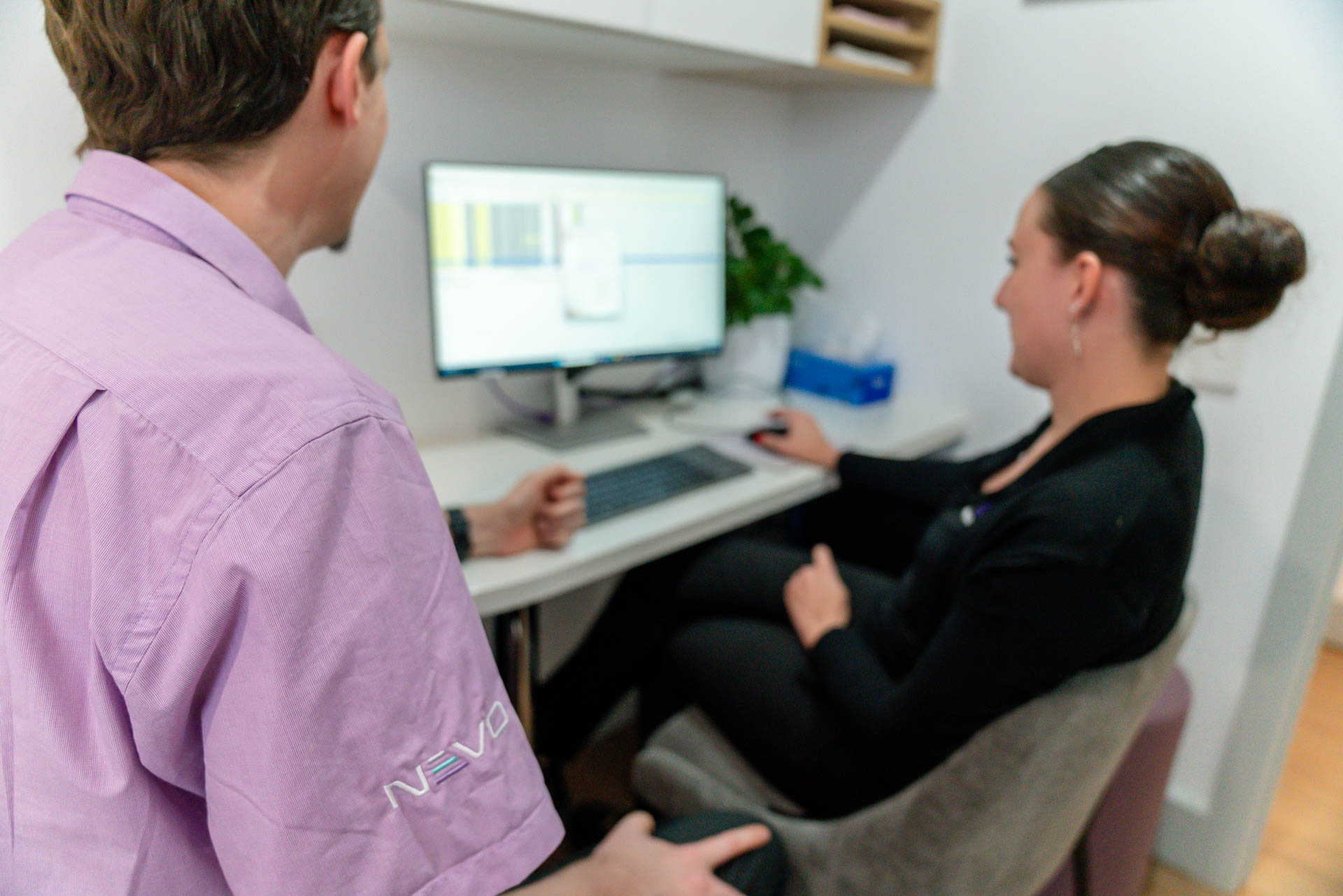
A ClubIT engineer in a NEVO-branded shirt sitting alongside a client staff member at her workstation, reviewing her screen together
A ClubIT engineer sitting beside a client staff member at her own screen — which is the whole argument of this page. The work happens next to your people, not in a datacentre.

Agree the outcomes

Goals, response commitments, guarantees and what success has to look like — written down and agreed before any work begins.

Before we start

Audit and plan

A structured onsite review across six areas, then a written findings report with prioritised risks, quick wins and gaps. Yours to keep regardless of what you decide.

1–2 hrs onsite · report in 5 days

Intensive improvement

Ninety days of real work in your real environment: support live, security hardened, backups proven by restore, infrastructure and cloud cleaned up.

Days 1–90

Sustain and improve

Ongoing management under NEVO, with a roadmap and reporting the board can read — and a standing review cycle so the improvement work keeps happening.

Ongoing

The first ninety days

What actually happens, and when.

Not a promise of activity — the real sequence. Support goes live in the first fortnight so your people feel it immediately; the slower structural work runs behind it.

Transition and documentation

Weeks 1–3

Handover from the incumbent, asset and licence register built, admin access recovered and documented. This is where inherited environments give up their surprises.

Support goes live

Weeks 1–2

Helpdesk opens, monitoring and management agents deploy, and your team gets access by portal, email, helpdesk button or 24/7 phone. Real tickets from day one.

Security baseline and hardening

Weeks 2–6

MFA enforced, admin rights reviewed, patching assessed, endpoint detection deployed. Essential Eight posture mapped and a remediation plan issued — so you can answer an insurer or auditor with a document rather than an opinion.

Backup and recovery verified

Weeks 3–5

We test restores, not backup status. You finish this stage knowing what can be recovered, how long it takes and what a real incident would cost you.

Infrastructure and connectivity

Weeks 4–9

Wi-Fi gaps, unreliable internet, ageing hardware and network performance, worked through from the audit findings. Anything that needs a regular reboot is already failing. Where replacement is needed you get a transparent quote and we run the project.

Microsoft 365 and cloud hygiene

Weeks 5–10

Licences audited against real usage, staff offboarding reviewed, email security configured, SharePoint and OneDrive structured. Usually pays for part of itself.

Roadmap, capital plan and automation scoping

Weeks 9–12

With the environment stable, we scope what is next: the five-year capital plan published in Pulse, and the automation and AI candidates worth doing, sequenced and costed into a roadmap you sign off.

Day 90 review

Week 13

We sit down and compare the environment against the audit baseline — what changed, what it cost, what is still open. If NEVO is not the right fit, you keep the audit, the report and ninety days of real improvement.

Live service from week one Improvement work Review point

Unique to NEVO

NEVO Pulse makes “improvement” checkable.

Every provider says they improve things. The definition at the top of this page promises it outright. Pulse is the part that means you don't have to take our word for it — it is software we built, and it is included as standard in every NEVO agreement, deployed to every client as their own portal. It is not an add-on, an upgrade tier or a paid extra.

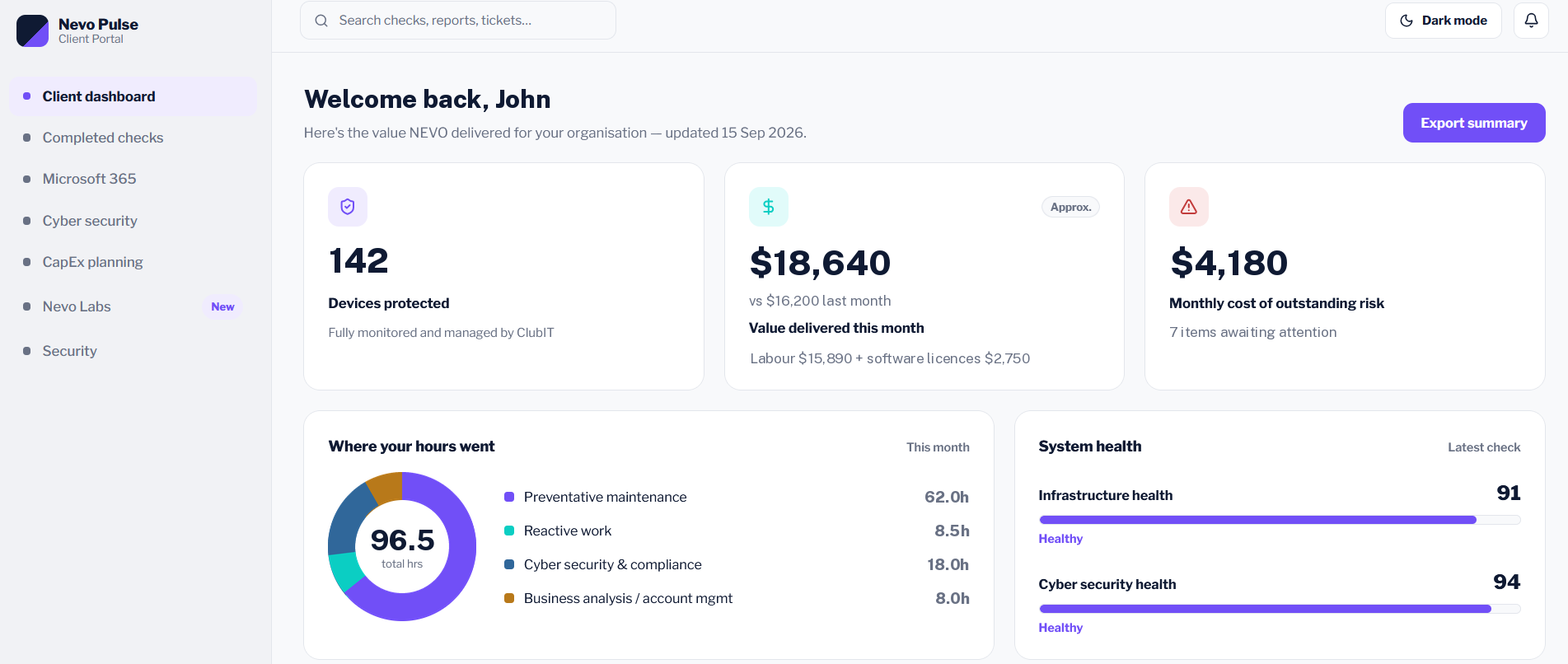
The NEVO Pulse client dashboard, showing devices protected, value delivered this month,
                  monthly cost of outstanding risk, a breakdown of where support hours went, and
                  infrastructure and cyber security health scores
The client dashboard. Demo tenant. Every figure here is one a client can open for themselves, on any day, without asking us for a report.

01 — The claim, audited

Preventative hours against reactive hours

“Designed to improve, not just maintain” is the sentence this whole page rests on. Where your hours went is the sentence turned into a number: preventative maintenance, reactive work, cyber security and compliance, and account management, split out for the month.

A reactive agreement cannot show you that chart, because under a reactive agreement almost all of it is the reactive slice. If our preventative hours are not beating our reactive hours, you can see it before we can explain it.

  • Value delivered this month, in dollars, split between labour and software licences, and compared against last month
  • The monthly cost of outstanding risk — the things we have flagged and you have not yet approved, priced, so a deferral is a decision rather than a drift
  • Infrastructure and cyber security health scores, from the latest check, not from the last time someone wrote a report
  • An export, so the board pack starts as a download instead of a rebuild
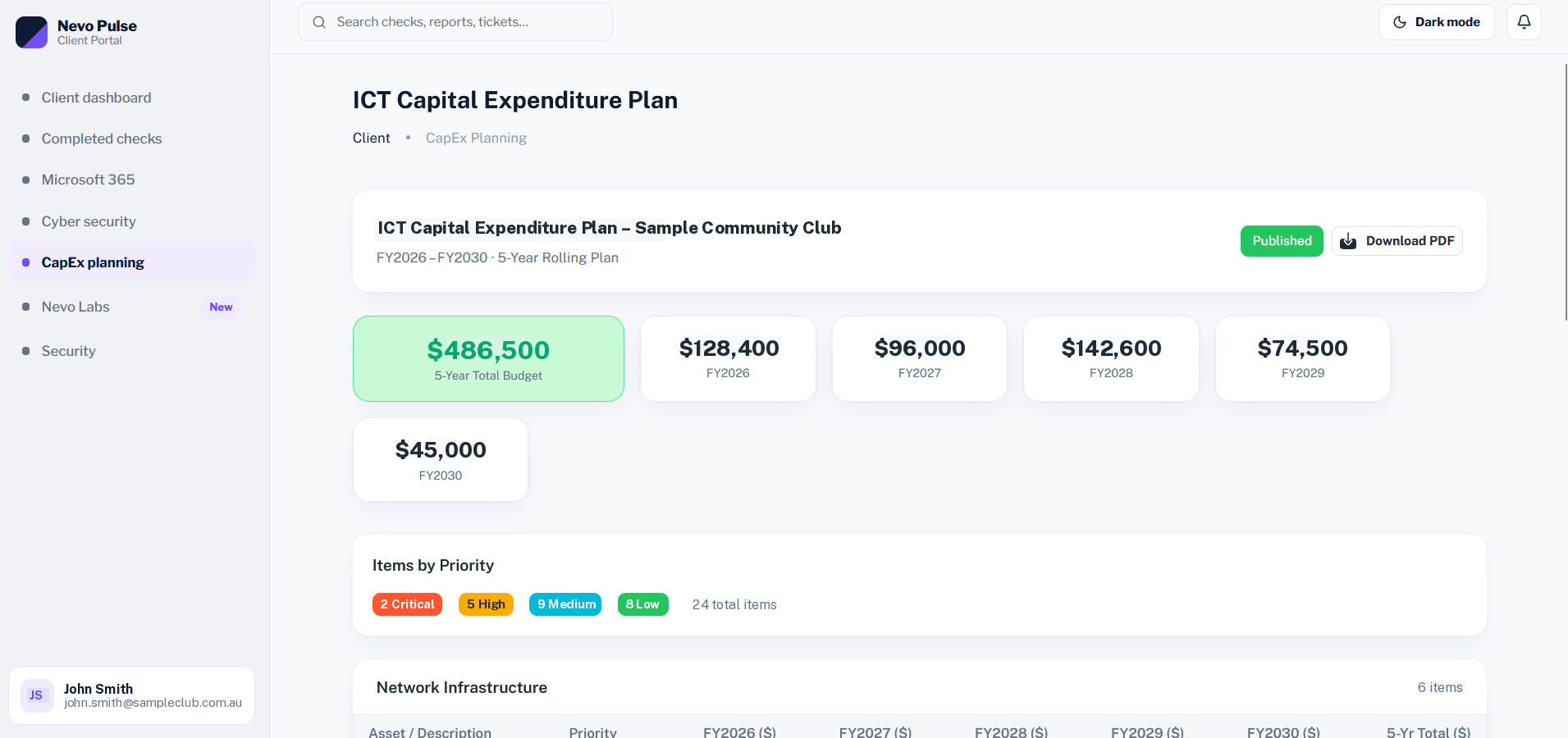
The NEVO Pulse CapEx planning page, showing a published five-year ICT capital expenditure
                  plan from FY2026 to FY2030 with a per-year budget breakdown, items grouped by priority, and
                  an asset table with a five-year total
CapEx planning. Demo tenant, and a partial capture — the asset table continues below the fold of the screenshot. A published, downloadable five-year ICT capital plan, costed per financial year and ranked by priority.

02 — The part nobody else does

A five-year ICT capital plan, published

Ask your current provider for a five-year capital plan for your technology, broken down by financial year, ranked by priority and signed off as published. Most cannot produce one, because nothing in a reactive agreement requires them to look past this month's invoice.

This is the difference between a lifecycle roadmap and an emergency. When a switch, a server or a venue's Wi-Fi reaches end of life, it is already a budget line in a year you have seen — not a surprise quote in the middle of a trading period.

  • FY2026 through FY2030, as a five-year rolling plan with a total and a figure against each year
  • Every item ranked Critical, High, Medium or Low, so what gets deferred is deferred on purpose
  • Grouped by asset class — network infrastructure, servers, endpoints — with a five-year total per line
  • Published status and a PDF download, which is the form a board paper actually needs

03 — Why it exists at all

We built it, which is the whole point

Most providers can offer you their vendor's portal. Pulse is ours — which is why it reports on the things NEVO actually commits to, rather than the things a generic PSA tool happens to measure. A reseller's portal will never show you the cost of outstanding risk, because no vendor ships that number.

It is also the plainest evidence for a claim made elsewhere on this site: ClubIT writes software. Pulse is what that looks like pointed at our own service — alongside the client dashboard it carries completed checks, Microsoft 365 and cyber security views, and NEVO Labs.

nevopulse.clubit.net.au →

Accountability

What “taking responsibility” actually means.

It is an easy phrase to write and a hard one to mean. Here is the specific version, including the parts that stay with you.

ClubIT owns this

  • The whole environment, not the devices. Endpoints, servers, network, cloud platforms, phones and the connections between them.
  • The vendors. We open the ticket, chase the escalation and sit on the call — including with suppliers we did not choose and do not resell.
  • The join between systems. When two suppliers each say the fault is the other's, that is our problem to resolve, not yours to referee.
  • Knowing your industry systems. Gaming, POS and membership platforms, or clinical and care systems — understood well enough to know what breaks and who to call.
  • Continuity being real. Restores tested, recovery times known and written down.
  • The forward capital picture. A five-year plan kept current, so replacement is budgeted rather than discovered.
  • Telling you what is wrong. Including when the answer is spend money, and including when a previous recommendation of ours did not work.

What stays with you

  • Decisions that commit money — we recommend and quote, you approve.
  • Third-party hardware, licences and subscriptions bought on your behalf. These are pass-through costs and are excluded from the guarantee.
  • Contracts you hold directly with a vendor, where we can coordinate but not sign.
  • Clinical, gaming and regulatory obligations that sit with your licence, not your IT provider. We support the evidence; we do not hold the obligation.
  • Staff following the process — we can enforce MFA, we cannot stop someone approving a prompt they should not have.

Stating the boundary is deliberate. An agreement that claims everything is an agreement nobody can hold you to.

Vendor coordination

We speak to your vendors so your team doesn't have to.

In most organisations we take over, the person coordinating six suppliers is an office manager or a duty manager doing it between other jobs. That is the first thing NEVO removes.

Platforms we manage directly

Our own stack, where we hold the partner relationship and the escalation path.

  • Microsoft 365
  • Azure
  • WatchGuard
  • Datto
  • Vonahi Security

Industry systems we coordinate

Your systems, your contracts. We hold the technical conversation on your behalf.

  • Gaming & POS
  • Membership & loyalty
  • Clinical & practice management
  • Care & rostering

Infrastructure suppliers

The ones that cause the most finger-pointing, so a single point of contact matters most.

  • Internet & NBN
  • Telephony
  • Wi-Fi
  • CCTV & access control

What that looks like weekly

We log the ticket, hold the reference, chase the escalation and report back. You get an outcome, not a case number and a suggestion to follow it up.

Roadmaps and reporting

What your board actually receives.

Pulse is always on; these are the moments someone sits down with you and takes a position on what it shows. The improvement half of NEVO only survives if it is reviewed on a cycle — this is the cycle.

Monthly

Service report

Tickets raised and resolved, response performance against the agreed commitments, patch and backup status, and anything that recurred. Short enough to actually be read. Across the client base we resolve more than 250 tickets a week, so this reporting comes out of a system already measuring at volume.

Quarterly

Roadmap and risk review

A working session, not a presentation: what moved on the roadmap, what did not and why, current cyber posture against the Essential Eight, and the next quarter's priorities re-agreed. This is where new sites, new services and budget cycles enter the plan.

Annually

Board-level technology position

One document a director can read without a technical background: where risk sits, what changed over the year, and the multi-year capital picture — which comes straight out of the five-year plan in Pulse rather than being assembled for the meeting.

On event

Incident and change reporting

Anything with real consequence gets written up — what happened, what we did, what stops it recurring. Independent penetration test results go the same way, with remediation tracked into the roadmap rather than filed.

The difference

Two operating models, side by side.

This compares two ways of structuring an IT agreement — not two companies. Good people do good work inside the reactive model every day. The argument here is about the model: it has no mechanism that makes an environment better, so improvement only happens in whatever time is left after firefighting.
Aspect The reactive model NEVO
How work starts Something breaks and someone logs a ticket. Agreed outcomes and a roadmap, set before any work begins.
What gets measured Tickets closed and time to first response. Risk reduced, disruption avoided and improvements delivered — with response performance as a floor, not the goal.
Preventative vs reactive Nobody counts. The split is whatever the month produced. Counted and published in Pulse every month, so the balance is visible to you as well as to us.
Who coordinates vendors You do. Your staff become the switchboard between suppliers. ClubIT holds the thread, including with vendors we don't supply.
Security Products supplied, installed, then left running. Managed, independently tested and reported on a cycle.
Continuity A plan in a folder and a backup that reports success. Restores tested. Recovery time known and written down.
Capital planning A quote when something fails, in whatever month it fails. A published five-year plan, costed per financial year and ranked by priority.
Improvement Whatever budget and attention survive the month. A funded roadmap, reviewed quarterly, with named owners.
What the board sees An invoice, and an escalation when something is bad enough. A live view in NEVO Pulse, monthly service reporting and an annual technology position.
Where it ends up The environment quietly accumulates workarounds until something forces a rebuild. The environment is measurably better than it was, against a baseline you both agreed.

The dissatisfaction themes behind this table came from market conversations. They are working hypotheses about a category, not measured claims about named providers, and nothing here should be restated as a statistic without evidence.

If you'd rather watch it

The NEVO overview.

Everything in this film is already written above — that is deliberate. The video is a shortcut for people who prefer one, not a substitute for the page.

ClubIT NEVO Overview · press play to load it. Nothing is requested from YouTube, and no YouTube cookie is set, until you do.

Everything said in the film is written on this page above it, so nothing here depends on being able to watch or hear it.

Proof

NEVO, in organisations like yours.

All results →
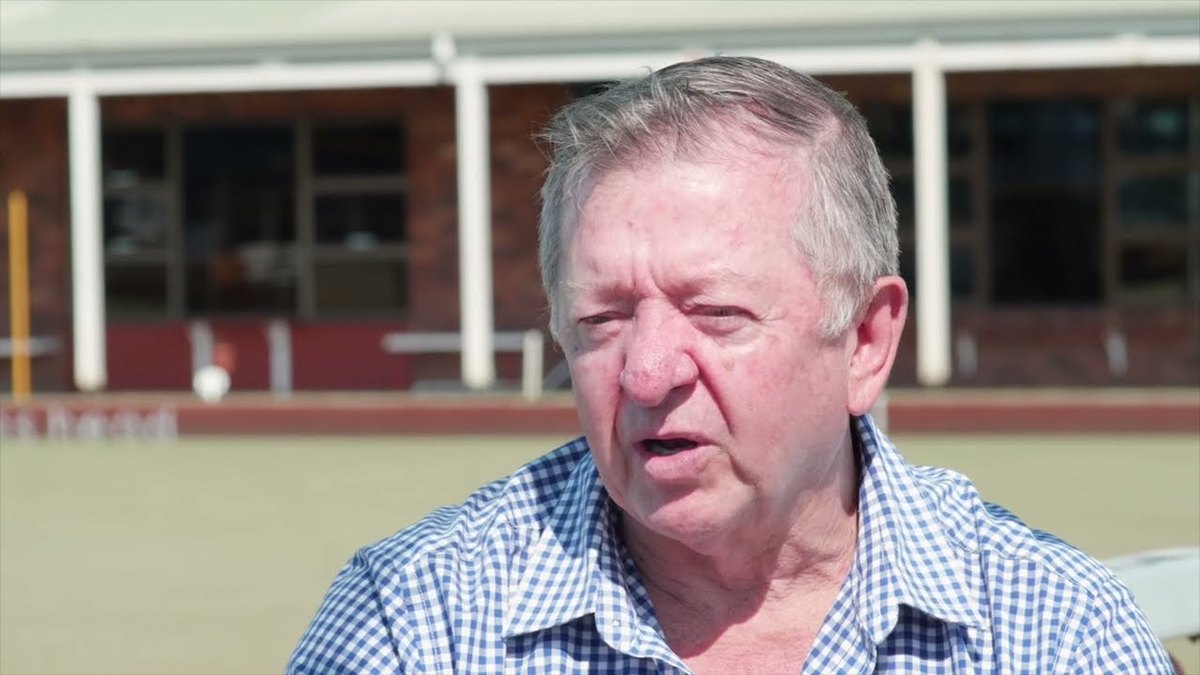
Roger Hong, CEO of Evans Head Bowling Club, speaking beside the greens

Clubs & Gaming · Evans Head, NSW

Proactive maintenance instead of major breakdowns.

“It's not so much what it costs you to have the service in place — it's the cost of when that service is not working.”

Roger Hong, CEO, Evans Head Bowling Club

Five years in, across the club and two offsite venues. This is the Support pillar working as designed: scheduled attendance and proactive maintenance, so the major breakdowns stopped being part of the year.

Read the case study →
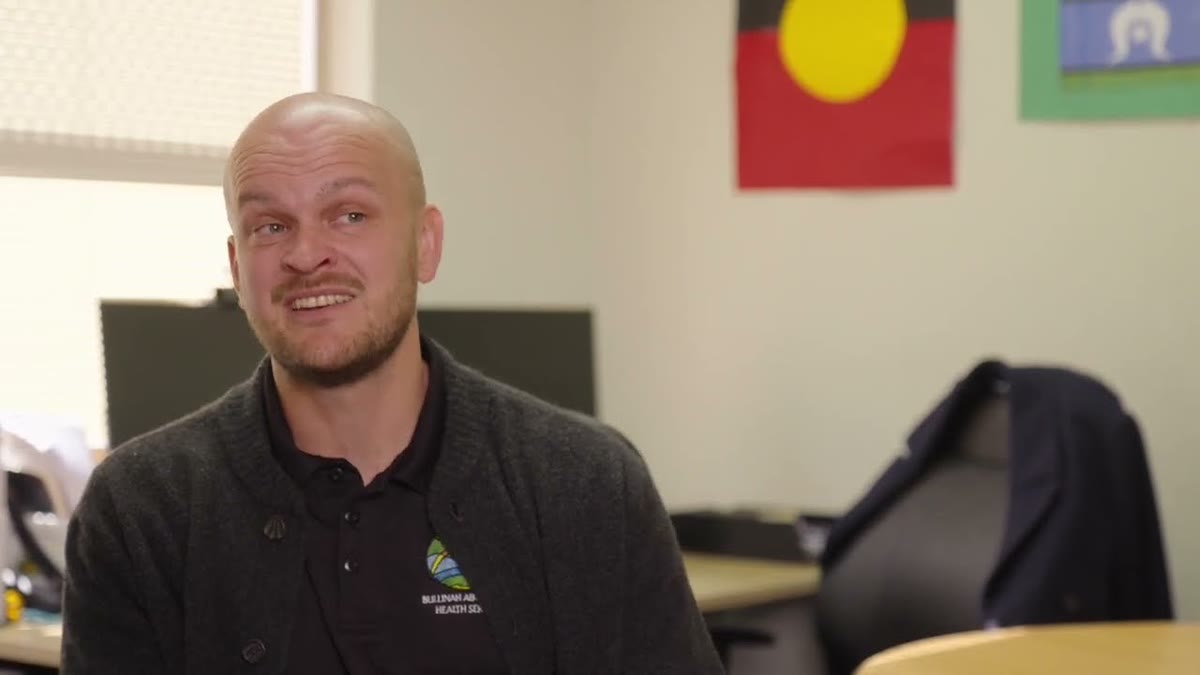

Payden Samuelsson, CEO of Bullinah Aboriginal Health Service, speaking in the service's offices

Aboriginal Community Controlled Health · Ballina, NSW

Audit, then prioritise against a real budget.

“They spent quite a bit of time trying to understand the organisation from multiple different people's perspectives… We saw significant improvements within the first month.”

Payden Samuelsson, CEO, Bullinah Aboriginal Health Service

Stage two of the four, described by the client: an audit of what needed replacing, then a joint conversation to rank it against budget and clinical criticality — which is what the capital plan in Pulse is for.

Read the case study →
Robyn Mortimer, Chief Financial Officer at St Andrews, Ballina, speaking in the grounds

Aged Care · Ballina, NSW

Cyber security on the front foot, around the clock.

“We're a 24/7 organisation — we need that sort of support. The service you provide to St Andrews is just above what I have experienced anywhere else.”

Robyn Mortimer, Chief Financial Officer, St Andrews, Ballina

The Secure pillar, in an organisation that never closes: support matched to a 24/7 roster, and a program that asks whether the right applications are in place before an incident asks it instead.

Read the case study →

See what NEVO would look like for your organisation.

It starts with a Technology Review: one to two hours onsite across support, cyber posture, backup and recovery, infrastructure, Microsoft 365 and where you're heading. You get a written findings report within five days — prioritised risks, quick wins and gaps.

$1,500 including GST. Credited in full against your engagement if you proceed.

The report is yours to keep regardless of what you decide to do next.

The 90-day guarantee. Give us 90 days. If you're not satisfied with our service in that time, cancel and we'll refund our fees. You keep the audit, the report and every improvement we've made. Third-party hardware, licences and subscriptions purchased on your behalf are excluded. Full terms

Book a Technology Review Let's talk — 15 minutes